Across the UK, local authorities and community energy groups face a common challenge: accessing and interpreting the wide range of data needed to plan retrofit programmes, low-carbon heating schemes, and local energy strategies.
The Fairer Warmth Data Platform bridges this gap by bringing together complex housing, energy and demographic data into one clear, map-based view. Through interfacing with the users of Fairer Warmth our Partner Organisations can make evidence backed planning decisions and provide targeted energy efficiency measures within their communities.
What does the Fairer Warmth Data platform offer?
The Data Platform is designed with those working on local area planning and energy efficiency planning in mind. Through it’s high-level view providing housing and Fairer Warmth user information, it allows users to highlight the wider patterns across communities and see where and which support is needed the most. Going beyond traditional ONS data, it combines the following complex data sources into one easy to use system.
Data Sources the Data Platform Combines:
EPC data, sourced from the Department for Levelling Up, Housing and Communities (England & Wales) and the Scottish EPC register, enhanced with predictive methods to fill gaps and achieve near-complete coverage.
Ordnance Survey data, providing detailed address and building geometry information.
Census and demographic data, capturing household composition, income indicators, education, and occupation.
Conservation areas and listed buildings, helping identify properties that may be harder to retrofit.
Substation and grid data, showing local electrical constraints and opportunities for low-carbon technologies.
How does this work?
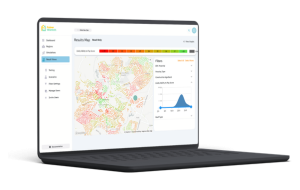
For each council or client, the platform visualises this combined data for their administrative areas. Users can explore the information through an interactive map, choosing from a range of categorical or numerical fields to overlay as colour-coded layers.
Powerful filtering tools make it easy to drill down into specific property types or neighbourhoods, supporting targeted actions such as identifying vulnerable households, prioritising areas for funding, or assessing retrofit feasibility.
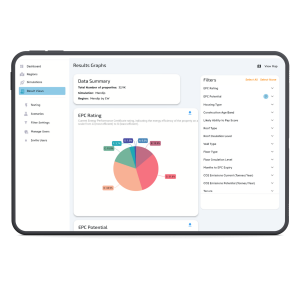
Alongside the map view, the platform provides charts and plots to show the distribution of homes by key factors such as age, EPC rating, or tenure. This helps with reporting and makes it easier to communicate insights across departments. Data can also be exported for deeper local analysis.
Tailored Insights to meet your needs:
Every local area is different, so the platform can include additional custom factors to meet each client’s needs. Examples include:
Ability to pay score – a weighted index combining census indicators to highlight where households may face financial barriers to retrofit.
Harder-to-treat factor – a composite score based on property age, construction type, and heritage status, showing where retrofit measures may be more complex.
Tailored Data – to support district heating planning, transport electrification, and roof top solar analysis. Made bespoke to help local areas align multiple low-carbon strategies within one shared evidence base.
These tailored indicators make it easier to visualise priorities, compare scenarios, and design fairer, more effective interventions.
The Fairer Warmth Data platform in action:
The Data Platform has already supported several councils and partners in planning their local decarbonisation efforts.
In Liverpool,
data from the platform was used to carry out a study estimating the cost, CO₂ savings, and financial impact of implementing four levels of retrofit and heating improvements. The housing stock was also classified into archetypes, providing a fuller picture of the city’s homes and the potential benefits of different interventions.
For a community benefit co-operative based in Sussex,
the platform supported a solar feasibility study by analysing roof geometry, slope, and orientation to identify which properties were most suitable for rooftop solar installations.
Want to use the Fairer Warmth Data Platform to deliver effective, data backed energy efficiency measures within your community? Find our contact details below to start the conversation